
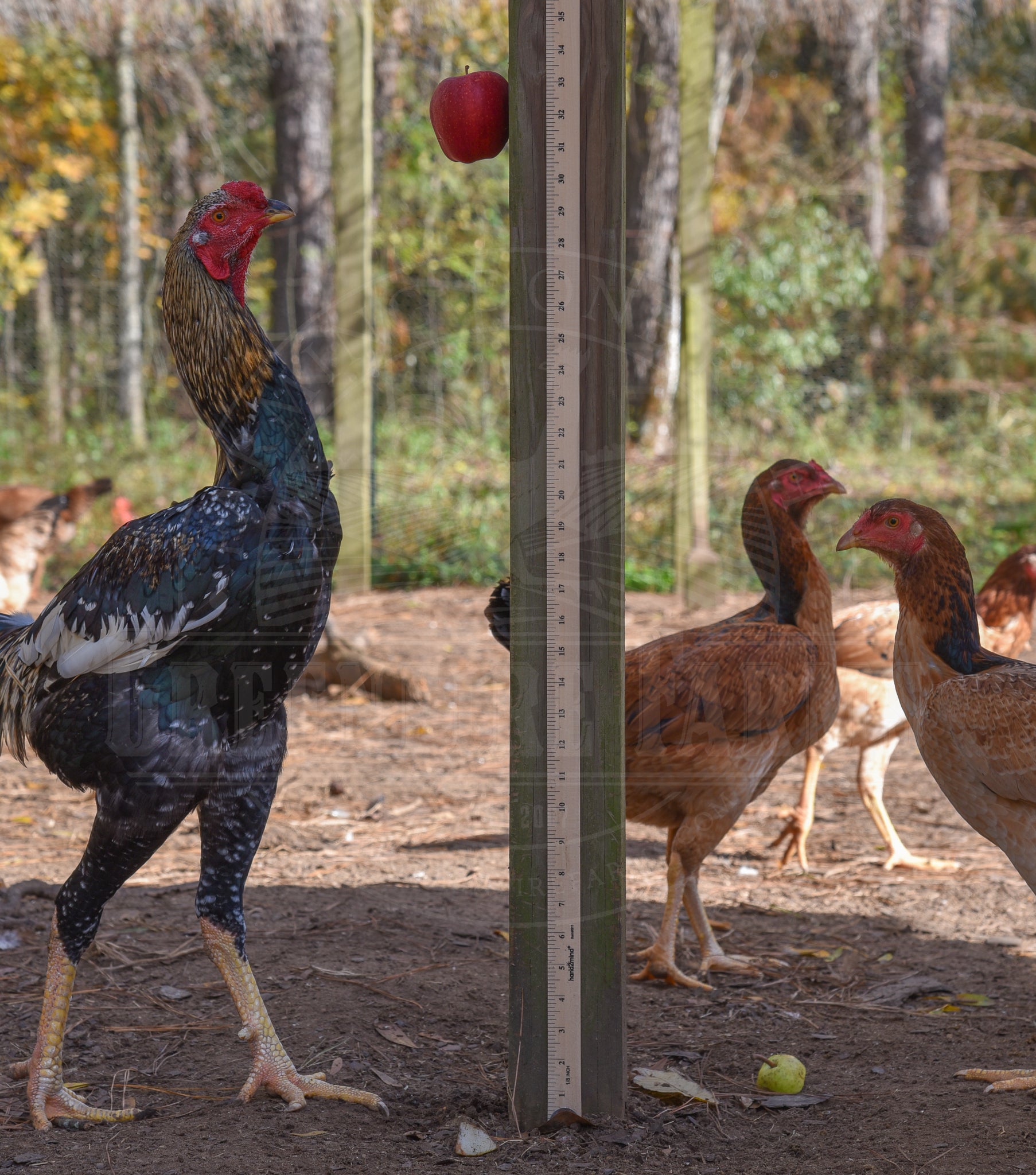


This legendary breed stands as the world’s tallest chicken—bridging the gap between barnyard bird and velociraptor!
Breed History
The Indio Gigante is a hard-feathered Brazilian chicken breed, characterized by feathers that lie tightly against the body with minimal underlying down. This gives the birds a distinctly lean, streamlined appearance. In Brazil, official measurements are taken with the bird fully extended, neck and legs stretched along a measuring board. Using this method, roosters routinely reach lengths exceeding 36 inches, with some measuring significantly more. Adding these pocket velociraptors to your flock is guaranteed to impress friends, family, and neighbors alike!
The Gigante breed is relatively new, having been developed in the Brazilian states of Minas Gerais and Goiás during the late 1980s and early 1990s. The breed was created through crossbreeding Malayoid breeds, such as the Malay and Shamo, with caipira chickens – rustic, mixed breeds native to Brazil, similar to a landrace. According to the Brazilian Association of Indio Gigante Breeders, this breed is expected to achieve recognition soon as the first Brazilian pure-breed chicken!
Appearance and Behavior
This breed has the long torso and neck typical of the Malayoid breeds, but in achieving its unique height, it has the added benefit of ridiculously long legs and huge feet. The height measurement is gathered by measuring from the tip of the toenail on the middle toe to the tip of the bird’s beak. While the roosters can easily reach heights of 36 inches the hens will typically measure in at 30 inches. Cue the Jurassic Park intro soundtrack…or should we say “Jurassic Peck”?
Regardless of how many nestboxes are provided, they inevitably designate one or two as their favorites. It’s not uncommon to find several hens squeezed into a single box—how they manage to fit remains a mystery, but they certainly rise to the challenge. On occasion, a hen waiting her turn will lay an egg from the perch above the nestbox, as though she simply couldn’t wait any longer. While this behavior doesn’t always make for the most efficient egg-collecting routine, it does highlight their determined personalities.
We use standard-sized nestboxes and have found no need to purchase or build oversized ones; the hens adapt perfectly well to conventional dimensions. On average, hens produce around 200 large, tinted eggs per year. They also maintain respectable productivity as they age—some of our four-year-old hens still lay approximately three eggs per week.
Despite their impressive size, these birds are generally quite calm. In our experience, roosters have not shown human aggression, with the exception of a single individual that was removed from our breeding program. Indio Gigantes are naturally curious and highly explorative. When we enter their pen, we’re typically greeted immediately and find them underfoot as they anticipate attention—or treats. Because we offer occasional snacks, they now expect them every time we step inside.
When given the chance to roam for an afternoon, their adventurous nature really shines. Some have hopped into farm vehicles, investigated the shelves in our garage, or selected the perfect sandy spot for a dust bath, even if that spot happens to be in the middle of our dirt road. Simply put, life with this breed is never dull!
For breeding, we’ve had excellent results with a rooster-to-hen ratio of 1:8 to 1:10. Fertility has proven higher than expected, and we routinely achieve viability rates of 80% or more.
Breed Standard
The most important characteristic of the Indio Gigante is its height. Ideally, birds selected for a breeding program should be no shorter than 30 inches for hens and 36 inches for roosters. They should also have clean legs, free of feathers, and red earlobes. As for their comb type, research shows either a pea, or walnut comb is accepted.
The Brazilian Association of Giant Indian Breeders does have a written standard of perfection, however, the link to their website is no longer active. In this link you can find a translated verison of the breed standard: Indio Gigante knowledge? : r/BackYardChickens
Hatching Eggs
We incubate at 99.5F and 55% humidity. Typically the average hatch rate from eggs that have been set into our hatcher is about 80%. After the chicks have hatched you will notice a variety of color patterns. The most common patterns are: yellow, yellow with orange, brown with a stripe down the chick’s back, and red with brown and yellow. But other colors may be observed as well.
Defects
When hatching Indio Gigante eggs, we recommend thoroughly inspecting the chicks’ combs. The ideal comb should be flat and wide on the day of hatching. Any chicks with a single-ridged comb should be culled. Additionally, this breed is clean-legged, so careful examination for feathering on the legs is essential. Due to the size of their legs and feet, crooked toes are a common issue, and any birds displaying this trait should not be used for breeding.
Notes
We often are asked how the hens and roosters do when introduced to an existing flock. The short answer is yes, you can add a Gigante hen or rooster to an existing flock and yes, they can do well in a mixed breed flock. Typically, hens are fairly simple to introduce. Not much to elaborate on, it’s pretty straightforward and normally there are no issues. You should expect the roosters to fight some upon meeting new roosters as they need to establish a new hierarchy. This will be the case with any new addition, no matter the breed. We haven’t noticed the Indio Gigante roosters being overly aggressive when meeting new roosters, however, the flock dynamic should always be considered – how much space do the birds have, how many hens are with the roosters, what is the age of the birds you are trying to integrate, etc. We haven’t had issues with having the Indio Gigante cockerels or roosters in our grow out pens, once they work out the hierarchy the birds coexist fine. We’ve even had the Gigante in a pen with bantam roosters and they coexisted peacefully. If you do experience a bad integration attempt, you will need to remove the new bird, make some changes to the pen setup or flock dynamic, and try again once the birds have had time to recover and rest. We are happy to answer specific flock dynamic questions if you are concerned about integrating your birds.
Since they are hard-feathered, they don’t tolerate harsh winters well, so if you live in a place with harsh winters you should expect to take extra steps, like offering supplemental heat, to make sure the birds are safe.
Import Notes
Greenfire Farms imported the Indio Gigante in 2019.
Indio Gigante
Indio Gigante chickens
Indio Gigante for sale
Indio Gigante chickens for sale
Indio Gigante hens
Indio Gigante hens for sale
Indio Gigante roosters
Indio Gigante roosters for sale
tallest birds
tall birds
tall chicken
brazil chicken
brazil chicken for sale
brazillian chicken for sale
Related products


